Wednesday, May 5, 2010

The Book of Myself


After Mom died, Lucy kept discovering interesting things she had left behind. One of the most fascinating was a do-it-yourself autobiography which someone must have given her (it was definitely not something she would have bought for herself).

Called "The Book of Myself", it is a blank diary with pithy statements at the top of each page which the diarist is meant to complete. For example:

"If I had any trouble with Mom growing up, it was in this area:"

MY Mom's answer? "None."

"If I had any trouble with Dad growing up, it was in this area:"

Again: "None."

"I wanted this person to be my friend, but the feeling was not mutual."

Mom: "No problem people!"

"This person significantly influenced my life growing up:"

Mom: "No one in particular."

"This is the profession I most often mentioned when people asked me what I was going to be when I grew up:"

Mom: "I don't remember being asked."

"I kept this secret from almost everyone:"

Mom: "No secrets!"

"One big misunderstanding with a friend:"

Mom: "None."

"I learned to take myself less seriously through my friendship with:"

Mom: "Not applicable."

"I regret having burned this bridge:"

Mom: "I do not recall having burned any."

"Of all my personality traits, I hope my family will remember this one about me:"

Mom: "No comment."

The whole book is like this. Page after page after page of searching questions or leading phrases, each one answered in three words or less, brushed off,  pushed aside, deemed irrelevant or - perhaps - impertinent. After the first few pages, the answers become predictable. You know for a certainty that there will be NO revelations here. Yet each question is politely responded to, as if the book had a power of its own, as if, in spite of having no intention of sharing anything personal, she still felt she had to answer.

There was one way she did reveal herself, however. Throughout the book, you can find her proof-reader's pencil at work: a comma added in the introduction, a redundant word crossed out in one of the headings, a misspelling silently corrected. 

But her own personal life is strictly off-limits: No mentors that she can recall, too many friends to list, no romantic interest other than her husband, no conflicts of any kind, no memorable teachers, no chores she disliked, no worries, no fears, no burnt bridges, no secrets!

Yet, what can we assume but that she had many secrets, and that she chose to keep them to herself? In fact, her reluctance to share personal details is itself a revelation of epic proportions, a clue to her selflessness and humility and, perhaps, the reason for her kindness and deep compassion. In this world of tell-all, over-sharing, and facebook bulletins, she really didn't think her hectic inner life was anything so amazing it had to be retailed to the world. And ironically, that means that her mystery and allure just go on increasing for me and many others who knew and loved her. What I wouldn't do to get to know her now, as an adult, to ask her about the things I can only guess at, to get a glimpse into what I am quite sure really WAS an amazing inner life . . .

Friday, April 30, 2010

The Baker's Privilege


Bread baking is a twice a week event in our house. I usually start it at around seven in the evening on those days when I want to be forced to stay up late to do some writing work. Since the whole process takes around five hours, that guarantees me a good solid stint of time to do what I need to do.

Bread making is such a lovely, slow, undemanding activity. It requires short bursts of concentrated effort followed by long pauses for rising which need nothing but a warm spot in which to happen. Sometimes, intent on my writing,  I may even forget the whole affair and then discover, to my surprise, a mound of dough so large and airy it looks like it could climb down off the counter and ooze out the front door. But dough is always forgiving. I punch it back down, butter the pans and shape it into loaves.

Once it's in the oven, it's almost impossible to forget. Bread baking fills a house with the strong, commanding fragrance of love and good will. Though everyone else is sleeping, they often tell me the next morning how hard it was to resist the urge to struggle out of bed and come to the kitchen for a slice.

I never resist. Ravi calls it the "Baker's Privilege" and I never fail to take it. The first slice, hot and crusty, loaded with lashings of butter, ah . . .

"What happens next
Is undiminished for having happened once,
Twice, ten, a thousand times before.
Who cares if all the music that transpires

Is the fall of grit or dry seed through a cactus?
You are like a rich man entering heaven
through the ear of a raindrop. Listen now again."

The simple joy of bread, the elemental pleasures of grain and honey and milk and leavening, brought together in a perfect slice. Twice a week, without fail. Twice a week, after midnight in my kitchen. I understand why Jesus chose bread.

Thursday, April 22, 2010

Cranky


Everybody who ever washes the dishes in our house (there are several people) puts the blue tray as you see it here. Every time I notice, I move it to the spot where I think it belongs, which is here:

I do it somewhat pointedly, hoping that the others will notice, but I cannot bring myself to say anything because I know it is verging on Cranky Old Lady Behavior and I already have plenty of other COLBs on my list:
  1. Can you PLEASE save some of the cold milk for me so I can have COLD milk in my tea and not hot? (You have to live in India to understand this one.)
  2. The GREEN bowl goes here and the GLASS bowl goes there.
  3. Can you please remember to hang the milk fluffer RIGHT SIDE UP so the water drains out?
  4. I'll make MY OWN TOAST, thank you very much.
Get it? The aggrieved EMPHASIS, the carefully courteous just short of irritated tone? AM I CRAZY? These things are totally meaningless to anyone but me and giving them any importance whatever is just a recipe for querulousness and unhappiness. Noted.

Put the tray wherever you like.

Wednesday, April 21, 2010

Babaji Does IM

Ravi is a Luddite both by nature and by persistent discipline (meaning he cultivates his Luddite Image). He has never learned to drive and finds most technology baffling and a waste of time. I will send him long, three-part text messages, full of double-entendres and sly jokes only he can understand, and I get "Good" or "OK" as a reply.

Those in the know always CC me on any email messages they send him, to be sure that he actually reads and replies (often via your obdt servant).

"Any news?" he asks cheerfully every morning, meaning "Have we (meaning me) heard from the kids?"

So I was stunned this morning when, seeing me in a lengthy online chat with Anand, he pushed me aside and started chatting himself. Chatting is a funny word to use for the laborious and painfully S-L-O-W process that ensued however. Anand continued to hammer away at the keyboard like it was a machine gun, while Ravi pecked carefully and diligently, scanning the keys for each letter as if it was the first time he was seeing a computer in his life. Anand's side of the conversation was in paragraphs, long thin columns of words, while Ravi's remained blank as he composed his thoughts, contemplated the keyboard, found the right sequence of letters, remembered the Enter button . . .

Finally I could bear it no longer.

I pushed HIM aside and told Anand: Call him. This ain't his medium.

A few minutes later, comfortably ensconced in the living room, he and his son engaged in a long conversation on the phone.

Back in the kitchen, I got a one-liner from multi-tasking Anand:

FYI: Baba is great.

Sunday, April 18, 2010

White Roof, Cool House

Many years ago, Ravi came up with a crazy idea: "Let's cover the roof with white sheets," he said one particularly scorching hot day. "I'm sure it will cool the house down."

We made a half-hearted attempt, but we didn't have enough sheets and we couldn't keep them from getting rucked up when the kids played on the terrace or when we hung the clothes there to dry.

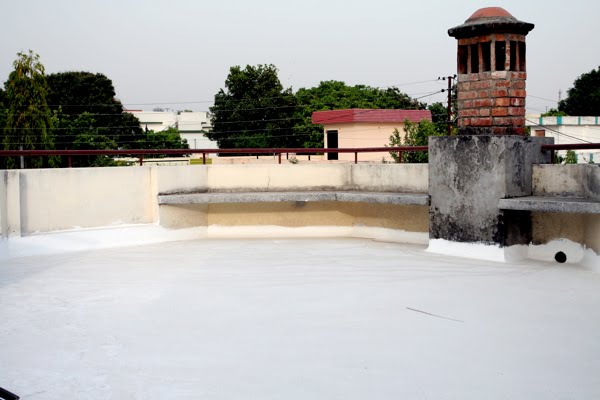
But the idea stayed in the back of Ravi's mind. This year, we finally decided to invest in doing it properly. We hired our old friend Atiq, who has been our house painter for years, and he and his team came and scraped down the moss and grunge from the roof and then laid down three coats of a dazzlingly white paint.

Now when we hang the clothes to dry at midday, we have to wear sunglasses. It's like sun on snow - BLINDING.


Later in the evening, it calms down a bit:


and the effect inside the house has been nothing short of miraculous. There is a difference of at least 4 degrees Celsius - sometimes, stepping into the house from outside, I feel like it's air-conditioned.

But that's not all. According to President Obama's Secretary of Energy Stephen Chu, if we all did this, it would have a dramatic effect on global warming - the equivalent of taking all cars off the road for eleven years! You can read all about it in any number of articles - this one from The Independent is clear and simple.

I cannot believe how much a difference this has made in our lives. I totally advise any of you with roofs to do it. It cost us 12,500 rupees.

Saturday, April 17, 2010

Old People and Babies

My friend Vibha, my source for so many wonderful ideas, articles, books and songs, sent me a link to this article from The Boston Globe. It's about a woman who fell in love at the age of 80 and it's written by her daughter, Joan Wickersham. The reaction of many of her friends on hearing about her mother's romance was predictable: "How cute!" they said. Or, "Isn't that adorable?"

Ms Wickersham's response was no, it's isn't adorable and my mother isn't cute. She's a mature woman who happens to have fallen in love. Why does that make us uncomfortable? Why do we need to infantalize her and speak of her relationship as we might about a child in pre-school with a crush on a classmate?

But it isn't just about love after 80 that we do this. We infantalize old people in myriad ways, and sometimes with their active cooperation. I've been thinking about this a lot because I have so many elderly people in my life and I often find myself thinking about them as if they are children. Sometimes I have to check myself because it feels disrespectful, but often it seems entirely appropriate.


As Mummy, Masiji and my Dad have aged, they have become increasingly dependent upon their children. Their frail bodies invite protection - we walk beside them as we would beside a child just learning to walk. An arm is always extended, we are always scanning the ground for the loose stone they could trip over or the stairs they may not be able to make without support. We can't rely on them to take care of themselves and we don't expect them to. Physical postures, for me, reinforce mental concepts. As they need more and more assistance, I feel more and more protective, more and more in charge.


They are all hard of hearing and find it difficult to follow what other people, especially if they are strangers, say to them. Like little children, they turn instinctively to me to interpret: English into English; Hindi into Hindi. It's the tone, it's the volume, it's the comfort they find in a familiar voice translating the world for them. I know which part of what they heard they didn't understand and I either glide over it or make the necessary adjustments to fill in the gaps. It's up to me.

That gives me a power I don't always enjoy. Who am I to be deciding what they will hear and what they will miss out on?  But there are some stories which are simply too complex to explain or which they wouldn't enjoy hearing, even though they don't know that in advance. I do know it, as we know what our children can handle and what will go over their heads or confuse them.

I know it, and yet I don't know it. While most of the time they are happy to be looked after, at times, they get impatient or irritated, remembering a time when THEY were the ones in control. Decisions about finances are particularly complex. It's their money, but they don't know how to spend it. They write a check without knowing whether they have enough in that particular account to cover it and when it bounces they are incensed about the bank charges.  They buy duplicates of everything because they have forgotten they already have them or foolish things which we must then dispose of.

The infantalizing of our elders is more complex than simply being uneasy about them still being interested in sex after 80. It's part of the circle of life and is in many ways a natural response to the reality of their increasingly baby-like states. Respectfully helping them navigate the shoals of old age with dignity intact is an incredibly delicate task demanding patience, insight and detachment.

But most important of all: a sense of humor and detachment on all sides. Laughing and letting it go has gotten us all through many "interesting" experiences here in our little vridh ashram.